
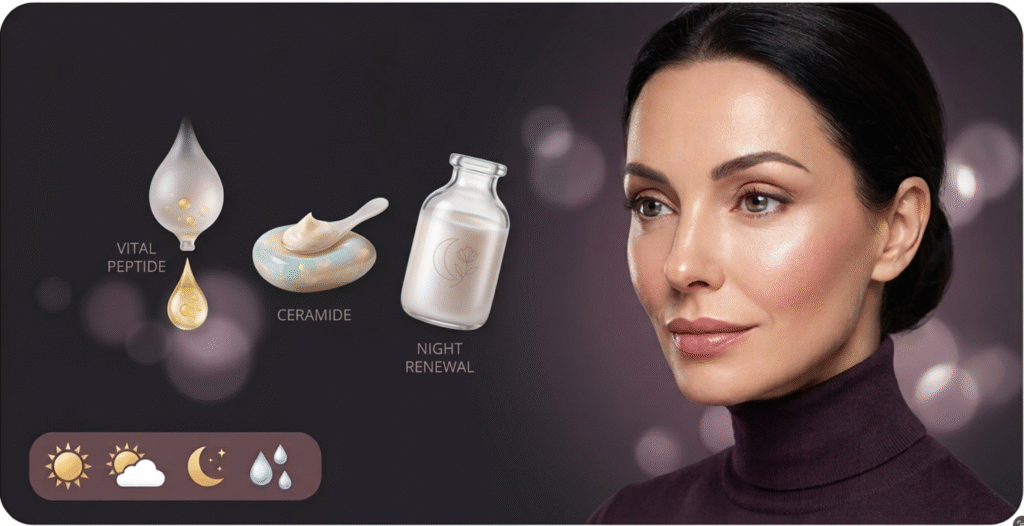
Perimenopause Skin 101: Understanding the Hormonal Shift
Disclosure: This blog may contains affiliate links, which means we may earn a small commission if you make a purchase through them, at no additional cost to you. We only recommend products and services that we personally use or genuinely believe in.
I still remember the morning my usual moisturizer simply stopped feeling like enough a new tightness settling in by midafternoon that no amount of reapplying seemed to fix, a texture along my jaw that hadn’t been there the season before. Around the same time, sleep grew lighter and more restless than I was used to, and I started noticing a kind of low-grade fatigue that no amount of coffee quite touched. There was a quiet irritability, too — short-fused in moments that never used to bother me, then oddly tearful ten minutes later, for no reason I could point to. None of it happened all at once, and none of it, on its own, would have seemed like much. But together, it was unmistakably my body beginning a new conversation with me, one I didn’t yet have the vocabulary for.
Perimenopause skin changes can feel sudden a new dryness along the cheeks, a dullness that wasn’t there last year, a jawline that no longer holds its line the way it once did. None of this means anything has gone wrong. It means your skin is responding, in real time, to one of the most significant hormonal shifts of your life, and understanding what estrogen actually does for skin is the first step toward caring for it with clarity instead of alarm.
This guide walks through what is changing beneath the surface, the four shifts you are most likely to notice, and a handful of trusted, widely available products that support skin through this transition without asking you to overhaul a routine that has otherwise served you well.
1. What Estrogen Does for Your Skin
Estrogen is involved in far more than reproductive health, it plays a direct role in collagen production, the lipids that hold your skin barrier together, and your skin’s ability to retain water. Research on skin aging consistently links declining estrogen to measurable drops in collagen density and skin thickness, particularly in the years immediately surrounding menopause.
This is why the earliest signs of perimenopause on skin tend to show up as dryness and heightened sensitivity, rather than as wrinkles. Collagen loss is a slower, cumulative process; the barrier and hydration changes tend to arrive first, and they are also the most responsive to a thoughtfully adjusted routine.
It can help to picture the skin barrier as a brick wall — skin cells as the bricks, lipids like ceramides as the mortar holding them together. Estrogen supports the production of that mortar. As levels decline, the mortar thins, and moisture escapes more easily through the gaps, which is exactly why skin that once felt comfortable all day can suddenly feel tight by early afternoon. Rebuilding that mortar, rather than simply adding more moisture on top, is the real work of a barrier-focused routine.
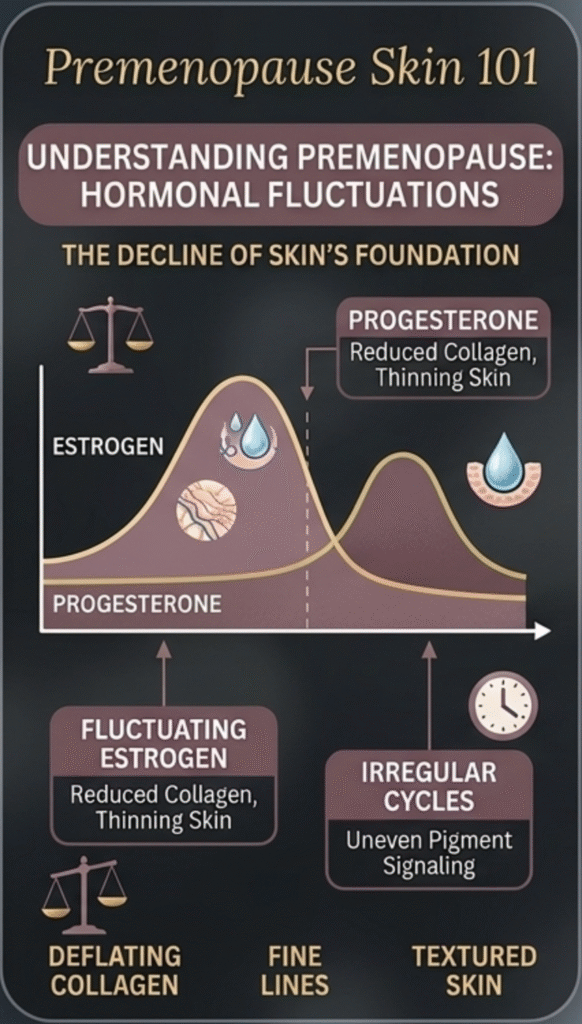
2. The Four Most Common Changes
Reduced Elasticity and Slower Bounce-Back
Skin may take a little longer to spring back after being pressed or stretched, and the lower half of the face can start to feel less firm by the end of the day.
A Thinner, More Reactive Barrier
Products that never bothered you before may suddenly cause stinging or redness, as the barrier’s lipid layer thins and becomes more permeable.
Uneven Tone and Slower Cell Turnover
Skin can look duller by mid-morning, and past sun damage or pigmentation may become more visible as cell renewal slows.
Increased Dryness Around Eyes and Mouth
These thinner-skinned areas are typically the first to show tightness or fine flaking, especially in air-conditioned or heated indoor air.
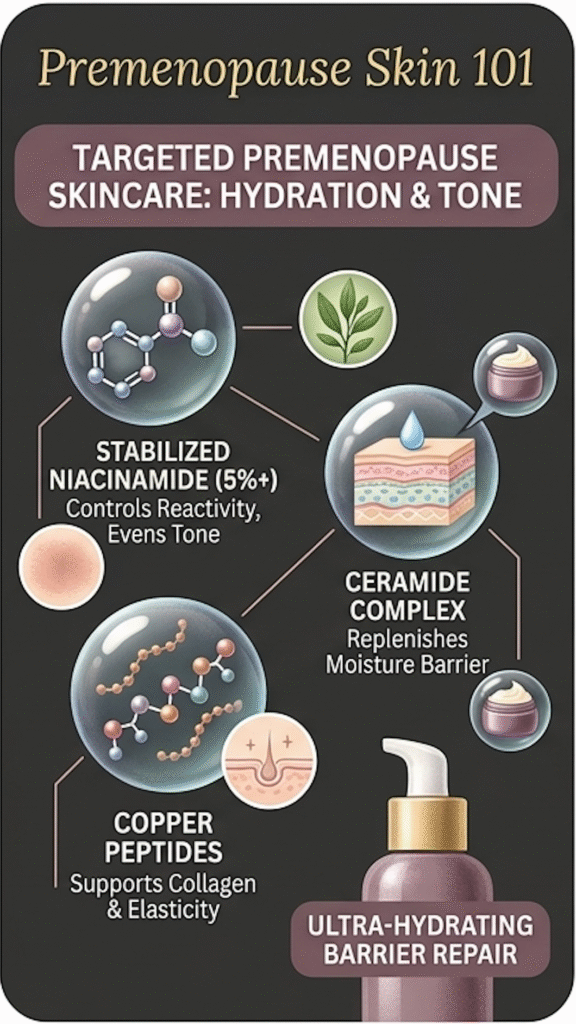
– Callout Box -Ingredients Worth Prioritizing
INGREDIENTS WORTH PRIORITIZING
Ceramides — rebuild and reinforce the weakening barrier
Peptides — signal collagen support without irritation
Niacinamide — calms reactivity while evening tone
Gentle retinoid alternatives — renewal without overwhelming sensitive skin
3. GlowAtime Picks: Products that Support This Stage
These are not a full routine overhaul, they are simple swaps or additions that target exactly what perimenopausal skin tends to need most: barrier repair, gentle renewal, and calm.
Illiyoon Ceramide Ato Concentrate Cream
FOR BARRIER SUPPORT
A ceramide-heavy, cholesterol-and-fatty-acid formulation specifically engineered to reinforce a compromised barrier, offering intense, long-lasting moisture for day and night use.
COSRX Snail Mucin 96% Peptide Booster Serum
FOR ELASTICITY
A multi-peptide serum designed to layer under moisturizer, offering gentle collagen-supportive signaling without the intensity of retinoids.
Cos De BAHA Niacinamide 10% + Zinc 1% Serum
FOR TONE AND REACTIVITY
An accessible, highly targeted formula featuring a matching 10% niacinamide and 1% zinc PCA combination to balance sebum, refine skin clarity, and soothe redness while keeping sensitive skin intact.
VT Cosmetics Cica Reti-A Essence 0.1%
FOR GENTLE RENEWAL
A sensitive skin-friendly retinol alternative blending Hydroxypinacolone Retinoate (a gentle Vitamin A derivative), Bakuchiol, and Cica to accelerate cellular turnover without the harsh peeling or stinging of conventional retinoids.
4. Adjusting Your Routine, Not Overhauling It
The instinct, when skin changes this noticeably, is to replace everything. Resist it. The more effective approach is almost always gentler, richer, and more consistent not trendier or more aggressive.
It helps to see the shift as a change in focus rather than a change in philosophy. The table below isn’t a prescription, it’s a snapshot of how the same basic routine categories tend to shift in emphasis once perimenopause begins, so you know which direction to lean as you adjust.
| Pre-Perimenopause Focus | Perimenopause Focus |
|---|---|
| Lightweight gel moisturizer | Richer, ceramide-based cream |
| Frequent exfoliation (3~4 times/week) | Gentler, less frequent exfoliation (1~2 times/week) |
| Strong retinol, used nightly | Gentle retinoid alternative, with rest nights built in |
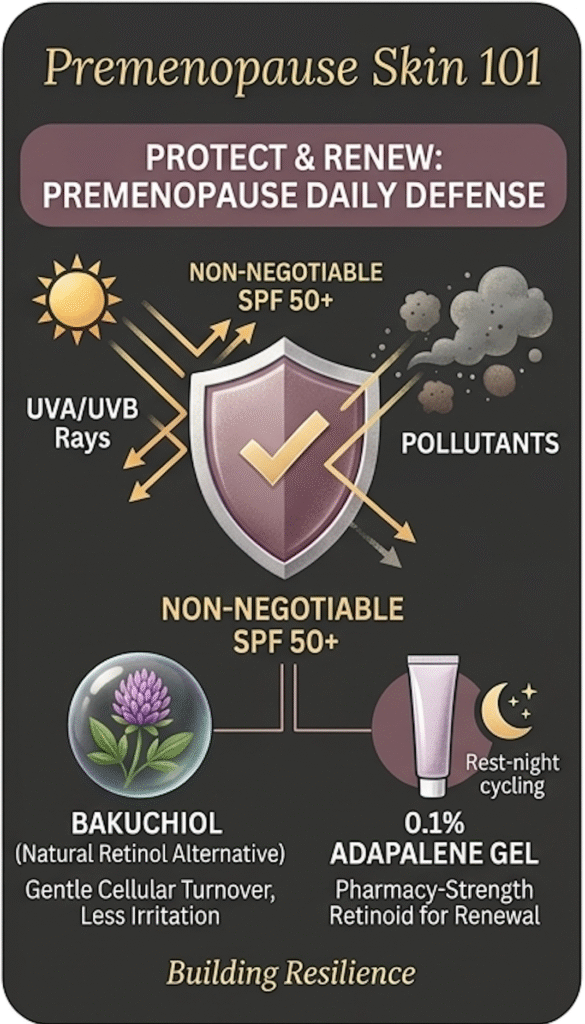
| Sunscreen treated as optional on cloudy days | Sunscreen treated as non negotiable, everyday |
| Routine changed often, chasing new trends | Routine kept simple and consistent for months at a time |
| Strong Retinol for Pre-Perimenopause | Gentle Retinoid Alternative / Rest-Night Built in for Perimenopause |
|---|---|
| SOME BY MI Retinol Intense Reactivating Serum FOR HIGH POTENCY RENEWAL A multi-action formula combining Retinol (0.1%), Retinal, and Bakuchiol to boost cellular turnover, support collagen production, and refine skin texture for those building high-tolerance daily routines. | VT Cosmetics Cica Reti-A Essence 0.05% FOR SOOTHING LOW-IRRITATION RENEWAL A sensitive skin-friendly option pairing micro-dosed Hydroxypinacolone Retinoate with Cica (Centella Asiatica) and Hyaluronic Acid to deliver gentle elasticity support while keeping the moisture barrier calm on non-rest nights. |
| Anua Nano Retinol 0.3% + Niacin Renewing Serum FOR INTENSIVE CELLULAR TURNOVER A high-potency renewing treatment utilizing nano-liposome technology to deliver a stronger retinoid complex deep into the skin, targeting stubborn fine lines, dark spots, and loss of firmness. | Beauty of Joseon Revive Eye Serum (Ginseng + Retinal) FOR GENTLE BARRIER-SAFE RETINIZATION Formulated with 2% liposome-stabilized Retinal and Ginseng extract, this slow-release formula provides effective anti-aging benefits with minimal risk of dryness or stinging, making it ideal for face-wide use on gentle skin-cycling schedules. |
If your pre-perimenopause routine leaned toward lightweight gels and frequent exfoliation, the shift is less about adding new steps and more about swapping textures a richer moisturizer in place of a thin lotion, a gentler acid in place of a strong one, sunscreen treated as non-negotiable rather than optional. Small, deliberate substitutions tend to serve this stage far better than a dramatic restart.
Why gentler, richer, and more consistent wins out over trendier and more aggressive comes down to what the skin barrier can actually tolerate right now. A thinning, more reactive barrier processes strong actives high-percentage acids, potent retinoids, frequent exfoliation far less predictably than it once did. What used to produce a healthy glow can just as easily produce redness, stinging, or a compromised barrier that takes weeks to recover. Richer textures and gentler actives aren’t a downgrade; they are simply better matched to what perimenopausal skin can absorb and use well.
Consistency matters just as much as gentleness. A routine that changes every few weeks, chasing whatever ingredient is trending, never gives skin the chance to show you whether something is actually working most barrier repair and collagen-support ingredients need six to twelve weeks of steady use before their effects become visible. Staying with a simpler routine for longer, even when it feels less exciting than trying something new, is almost always the more effective choice during this stage.
It is also worth building in more recovery time between active ingredients. Where skin once tolerated a retinoid and an acid exfoliant on back-to-back nights, perimenopausal skin often prefers a rest night in between not because it has become weaker, but because it is working harder to repair itself, and needs the space to do so.
Sun protection also deserves a second look during this stage. Estrogen decline appears to reduce skin’s own defenses against UV-related damage, which means sunscreen that once felt like an optional finishing step becomes one of the most protective things you can do for collagen that is already under new pressure. A broad-spectrum SPF 30 or higher, reapplied through the day, is one of the few changes with outsized impact for very little added effort.
5. GlowAtime Take
It helps to think of this stage as recalibration rather than decline. Your skin is not failing to keep up, it is adjusting to a genuinely new hormonal baseline, the same way it adjusted during puberty or pregnancy. Meeting it with curiosity, rather than urgency, tends to produce better results than any single product ever could.
If dryness, sensitivity, or tone changes feel sudden or severe, it is always worth a conversation with a dermatologist some of what shows up during perimenopause overlaps with other treatable skin conditions, and a professional eye can rule those out with confidence.
It is also worth naming what this stage is not. It is not a sign that your skincare has failed, and it is not a countdown to some fixed, worse version of your skin. Hormonal transitions are not new territory for your body, it has navigated major shifts before, at puberty and, for many, through pregnancy and it is capable of finding a new equilibrium here as well, especially with a routine that meets it halfway.
– A Few Questions Readers Ask
Is it normal for my skin to react to products I’ve used for years?
Yes. A thinning barrier can make once-tolerated products feel irritating. Simplify temporarily, then reintroduce actives one at a time.
Do I need hormone-specific skincare?
Not necessarily. Ingredients like ceramides and peptides support the skin changes at play regardless of how they’re marketed.
Will these changes reverse after menopause?
Skin tends to stabilize at a new baseline rather than reverse — which is why adjusting your routine now, rather than waiting it out, makes a real difference.
Should I change my routine gradually or all at once?
Gradually. Introduce one new product every one to two weeks, so that if irritation appears, you know exactly which change caused it.
Does diet or sleep make a measurable difference here?
Yes, though modestly. Adequate protein, omega-3 fats, and consistent sleep all support the same collagen and repair processes your skincare is targeting — think of them as working alongside your routine, not replacing it.